One layout feature found in abundance in RPGs, especially in old school systems, is the table. A table can organize information in a fashion that efficiently conveys the ideas involved, providing concise statements of information. The Turning Undead table, for example, lays out the chances for clerics to turn or destroy undead creatures while also providing a gauge for how tough the different undead types are to encounter.
Tables can also help decide among a variety of options via dice rolls, as with encounter tables for wilderness travel or random dungeon encounters. Those are the tables I want to look at here. I’m interested in taking the basic tables long used in rules systems and expanding on them a bit.
I’ve written before about wanting to use some large table types. Reality sat me down for an intervention and showed me that laying out such large tables wasn’t quite practical, even using a two-page spread. The cells on the table shrink to barely usable with such a size. So, I’m here to press more conventional tables into service.
The many systems that have been published over the decades all use tables of some sort, so the usage of tables to provide information in RPG systems isn’t new or unusual. D6 tables, D10, D20, D30, D100 tables abound in the published literature. While they all can prove useful, I’m mostly interested in those found in old school and OSR materials, specifically those using multiple dice in some fashion.
The venerable reaction table, for example, calls for 2D6 rolls. An OSR system favorite is the D66 table. Each of these types can be expanded to increase the range of results in ways that can serve a setting better and provide a bit more flavor to the rules.
The reaction table is a a single-axis table, meaning the roll indicates which row on the table to use to find a result. We can, however, expand the number of rows to add some interesting utility to the table. We can expand both the top and bottom of the table, so the lowest result is less than the lowest dice roll of 2, and the greatest result is greater than the highest dice roll of 12.
What this does is allow for a wider range of results and move the more extreme results — hostility resulting in immedate attack and all-in friendly helpfulness — outside the bounds of a default roll. To garner a result from the expanded rows, the roll has to be modified and that provides a chance for the players to wrangle modifiers in their favor. A look at a potential reaction table:
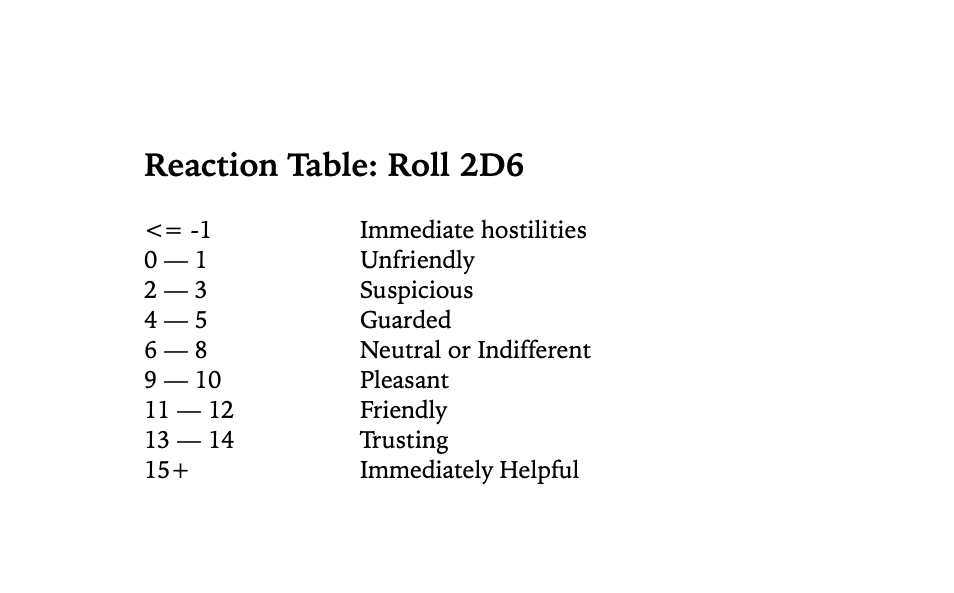
The five results from the standard table have now expanded to nine results, which allows a bit more nuance in play. It also allows for added interactions to shift results for better or worse, facilitating more interaction before either extreme can occur.
Now let’s look at an encounter table. By expanding the number of rows, we can reflect increased danger in deeper levels of a dungeon or risk increasing the more time is spent in a location. The more dangerous the area or longer the PCs have been in a risky place, the greater the modifier to the roll and the more dangerous the entries on the table become. A 2D6 table that has goblins as the most likely critter encountered now has gnolls as the most likely with a modifier shifting roll results, and the possibility of owlbears as the most powerful.
Now, we can also expand the number of columns available. Using a D66 roll, or adding a D6 alongside a 2D6 roll, allows us to shift things in a different direction. The D66 becomes a possible D68, so to speak, as a modifier of one or two column shifts moves us into options not part of default rolls.
Expanding a table in both directions allows us to color the results in more than one fashion. If we add rows, we can tie modifiers for that to one element, say level of dungeon in a dungeon crawl. Then, we can add columns to the table that reflect the time spent in the current level and how that increases the chances of stirring up more of the inhabitants. Or we can have the expansion in one direction reflect moving into a different area of the level that has more active or dangerous inhabitants. Or an increased chance of cave-ins or geothermal vents spraying steam or whatever.
In this fashion, the regular 36 possible results of a D66 table can be expanded to, say, 64 possible results by allowing for modifiers of +1 or +2 in each direction. I’m looking at using a 2D6x6 table format to take advantage of the bell curve, so that involves 66 possible results of varying likelihood. (The 2D6^2 table format I wanted to use — 121 possible results by default and bunches more with expansion — just doesn’t fit well in a rulebook, alas.)
This is, of course, just a cursory look at expanding tables and how they could be used. The true utility has to be worked out in game materials and used at tables to see how they’re best used. I’ll be hashing out expanded tables in the materials I’m preparing, so concrete examples will be found therein.