I’ve been struggling with crafting a cast of characters for a campaign start area. Then I realized I could approach it in a different fashion and suddenly the NPCs started springing up left and right. I’ve no idea why the change let the creative juices flow where the approach I’ve used for decades suddenly dried everything up. Ah, well, ideas are bubbling up and I figured it worth sharing.
I was thinking about a friend who has been an inspiration for an important NPC. I realized that I wasn’t really trying to put her into the setting, I was using her as an inspiration and it was much more like I was casting her to play that character on the world stage. That brought the epiphany — I’m a director casting people in parts for a play.
I found that this approach works well in two directions. That is, taking an NPC role and figuring out who I’d cast to play that part; and also considering a person I know in some fashion and figuring out what sort of role I’d cast them in. Note that I’m not considering basing the NPC on the person’s actual personality, I’m just considering how I’d cast them in a play based on how I think they’d play the NPC.
I’ve never overtly considered this as an approach to NPCs prior. I’ve rarely even thought of correlating a known person with an NPC in my games. I expect there are people who’ve taken this approach, though I’ve not encountered discussion of it anywhere.
One layout feature found in abundance in RPGs, especially in old school systems, is the table. A table can organize information in a fashion that efficiently conveys the ideas involved, providing concise statements of information. The Turning Undead table, for example, lays out the chances for clerics to turn or destroy undead creatures while also providing a gauge for how tough the different undead types are to encounter.
Tables can also help decide among a variety of options via dice rolls, as with encounter tables for wilderness travel or random dungeon encounters. Those are the tables I want to look at here. I’m interested in taking the basic tables long used in rules systems and expanding on them a bit.
I’ve written before about wanting to use some large table types. Reality sat me down for an intervention and showed me that laying out such large tables wasn’t quite practical, even using a two-page spread. The cells on the table shrink to barely usable with such a size. So, I’m here to press more conventional tables into service.
The many systems that have been published over the decades all use tables of some sort, so the usage of tables to provide information in RPG systems isn’t new or unusual. D6 tables, D10, D20, D30, D100 tables abound in the published literature. While they all can prove useful, I’m mostly interested in those found in old school and OSR materials, specifically those using multiple dice in some fashion.
The venerable reaction table, for example, calls for 2D6 rolls. An OSR system favorite is the D66 table. Each of these types can be expanded to increase the range of results in ways that can serve a setting better and provide a bit more flavor to the rules.
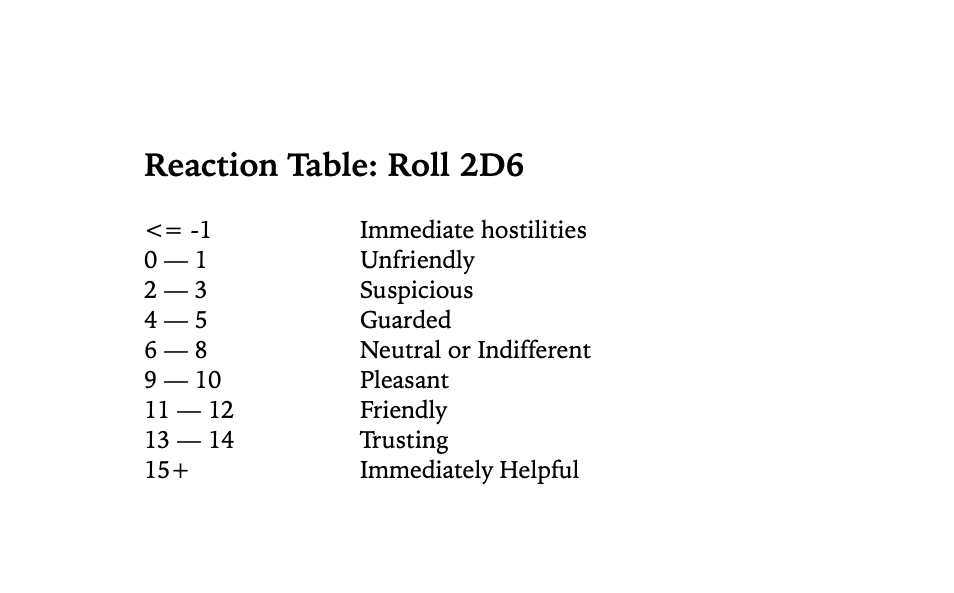
The reaction table is a a single-axis table, meaning the roll indicates which row on the table to use to find a result. We can, however, expand the number of rows to add some interesting utility to the table. We can expand both the top and bottom of the table, so the lowest result is less than the lowest dice roll of 2, and the greatest result is greater than the highest dice roll of 12.
What this does is allow for a wider range of results and move the more extreme results — hostility resulting in immedate attack and all-in friendly helpfulness — outside the bounds of a default roll. To garner a result from the expanded rows, the roll has to be modified and that provides a chance for the players to wrangle modifiers in their favor. A look at a potential reaction table:
The five results from the standard table have now expanded to nine results, which allows a bit more nuance in play. It also allows for added interactions to shift results for better or worse, facilitating more interaction before either extreme can occur.
Now let’s look at an encounter table. By expanding the number of rows, we can reflect increased danger in deeper levels of a dungeon or risk increasing the more time is spent in a location. The more dangerous the area or longer the PCs have been in a risky place, the greater the modifier to the roll and the more dangerous the entries on the table become. A 2D6 table that has goblins as the most likely critter encountered now has gnolls as the most likely with a modifier shifting roll results, and the possibility of owlbears as the most powerful.
Now, we can also expand the number of columns available. Using a D66 roll, or adding a D6 alongside a 2D6 roll, allows us to shift things in a different direction. The D66 becomes a possible D68, so to speak, as a modifier of one or two column shifts moves us into options not part of default rolls.
Expanding a table in both directions allows us to color the results in more than one fashion. If we add rows, we can tie modifiers for that to one element, say level of dungeon in a dungeon crawl. Then, we can add columns to the table that reflect the time spent in the current level and how that increases the chances of stirring up more of the inhabitants. Or we can have the expansion in one direction reflect moving into a different area of the level that has more active or dangerous inhabitants. Or an increased chance of cave-ins or geothermal vents spraying steam or whatever.
In this fashion, the regular 36 possible results of a D66 table can be expanded to, say, 64 possible results by allowing for modifiers of +1 or +2 in each direction. I’m looking at using a 2D6x6 table format to take advantage of the bell curve, so that involves 66 possible results of varying likelihood. (The 2D6^2 table format I wanted to use — 121 possible results by default and bunches more with expansion — just doesn’t fit well in a rulebook, alas.)
This is, of course, just a cursory look at expanding tables and how they could be used. The true utility has to be worked out in game materials and used at tables to see how they’re best used. I’ll be hashing out expanded tables in the materials I’m preparing, so concrete examples will be found therein.
More thoughts on what makes for an old school experience. Some of this is simply expansion on a topic mentioned in Hallmarks I because I think the added commentary adds something to the discussion. As I return to thoughts of playstyles, I expect more details and notions to arise and I’ll toss them up here. Perhaps I’ll get around to pulling all of it together, properly organized, and then post it.
I’ve offered that settings are what define the world in which PCs operate. Any exceptions to normal physics are delineated so that players can interact with a consistent basis of understanding; gravity is going to make a long fall quite detrimental to a PC’s health…although here are the specific ways in which that can be ameliorated. Players are able to predict, in general terms, how things work and thus gauge how risky a course of action will be for the PC.
Settings also tie in with other elements. PCs are expected to be grounded in the setting, with some nominal ties to specific elements. The most basic is likely that of origin; where the PC comes from establishes them as *part of the setting* from the outset. The PCs aren’t foreign to the setting, they’re just another one of many elements that are part of the setting.
That’s important because old school campaigns are about the setting. The system rules didn’t include anything about pre-planned “character arcs” or long, involved background stories because the campaigns were expected to be about what’s going on in the world and how a group of random characters engage with it. With everything involved being part of the setting, it’s the setting that is featured in play. It’s this that makes every PC replaceable in a campaign, with it not unusual that a player could begin a campaign and then change PCs over time without that campaign ending.
A system begins to lose old school flavor when the approach to PCs loses tight definition in an effort to provide a lot of customization. As the ancestral wargames offered up a “fighter is a fighter is a fighter” approach, the old school RPGs proceeded with that idea, I reckon, because it kept the PCs grounded in the setting and helped to make them replaceable. The expectation was that a PC becomes memorable based on how it’s played with the choices the player makes defining the unique nature of the character. Thus, a character is only fully defined through play and that’s where the important differences should arise.
I’ll even offer that this is part of developing player skill, in part — take this standard-issue archetype and make something more of it *in play.* So much of the play experience and character definition happens “off-sheet,” as is often said. Players can’t rely on special combinations of customization options to provide “easy button” solutions to play challenges, a build isn’t a substitute for creative solutions the player cooks up. The character sheet acts as a toolbox for the player, not a source of solutions; interrogating the fiction by asking questions to find elements that can possibly be exploited to help overcome the challenge at hand is far more important than looking to the sheet for an answer.
Old school play is very much in the “play to find out” camp. Even in tournament play, while each round of the tournament provided a continuation of a general plot, the individual installments often didn’t dictate an explicit sequence of encounters and events. G1-3 Against the Giants, for example, moved the overall plot from round to round from G1 with hill giants to G2 with frost giants and then to G3 and fire giants. When playing through G1, however, there was no expected order of encounters as to how it would play out, nor do I recall any instances of “the PCs have to do X then Y” or similar to finish the module.
Forgotten Temple of Tharizdun, with its order of battle roster, makes this even more apparent. PCs can have denizens appear during a fight with others and then, when arriving at those critters’ regular quarters, there won’t be any critters to be found. The module doesn’t decide if the critters will be encountered during the large melee, in their own quarters, or somewhere in between. That lack of expectation and reliance on the GM to sort the happenstance is representative of an old school approach.
Old school systems also expect exploration as an important component of play. this hearkens back to the importance of setting, because finding out what is in the setting and what’s happening in the setting is core to the experience. Exploration becomes important as a way to find out about the setting, as the setting provides for play. A solid procedure for exploring sites thus seems to be a requirement in old school playstyles.
I hope my thoughts here can spur thought and spark ideas from other people. I can’t say that my idea of the hallmarks of old school styles are necessarily the most accurate or thorough, certainly. I can say that thinking on the subject has helped me deepen my understanding, certainly.
I’ve roughed out a Witch class for the DA project. The class will be quite similar when it appears as an LJ class.
I’d love to hear ideas on more powers for Witches to be able to develop, as the list I have seems a bit short. I’ll be basing the spell descriptions and lists on those powers.
Feedback on the abilities described also welcome…shoot, feedback on all of it is welcome, at this point. I think I’ve conveyed the gist of the class reasonably well and I’d like to know how it comes off to you.
I realized that I might be able to post other media in addition to images. Sure enough, I can put PDFs and other types of file up. Yeah…I’m not quick to check on this sort of thing.
Anyway, I still have no idea how to go about accessing those through the guest interface, so I’ll check to see how difficult that is.